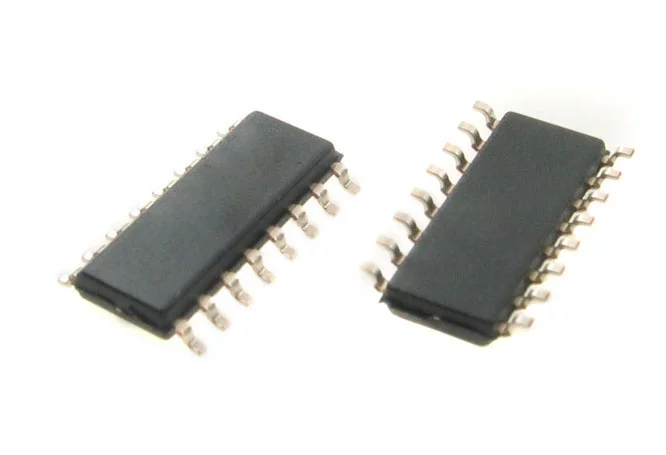
Affordable LED Display Drivers from TDSEMIC
Affordable LED Display Drivers from TDSEMIC
The HTM1628, HTM1640 and HTM1650 are part of a family of dedicated drivers designed to control multiplexed LED displays. Instead of controlling individual LEDs directly from a microcontroller, the MCU sends data to the driver via a serial interface. The driver handles data latching, multiplexing and display control. All three ICs also offer brightness adjustment, allowing the microcontroller to select one of eight brightness levels without implementing its own PWM control.
However, the three devices differ mainly in their supported display configurations, communication interfaces and keyboard scanning capabilities.
HTM1628 offers the most flexible display configuration. It supports configurations ranging from 4 to 7 GRID positions and from 5 to 13 SEG segments, with the number of available SEG and GRID lines depending on the selected operating mode. Supported configurations include 10SEG × 7GRID, 11SEG × 6GRID, 12SEG × 5GRID and 13SEG × 4GRID. For example, the 10SEG × 7GRID configuration allows control of an LED matrix containing up to 70 LED points. Another distinguishing feature of the HTM1628 is its keyboard interface, which supports scanning a matrix of up to 10 × 2, or 20 key positions. This eliminates the need for the microcontroller to continuously scan all keys itself.
HTM1640 is primarily designed for LED display control. It supports a fixed configuration of 8SEG × 16GRID, providing control of up to 128 points in a multiplexed matrix. The IC supports common-cathode LED displays. Communication with the microcontroller is handled via a simple two-wire serial interface (CLK + DIN). The HTM1640 also features a built-in automatic blanking circuit that temporarily disables LED outputs when switching between display positions. This helps reduce unwanted brief segment illumination caused by transient states during multiplexing.
HTM1650 combines LED display control with extensive keyboard scanning capabilities. It supports two display modes: 8SEG × 4GRID and 7SEG × 4GRID, making it particularly suitable for typical four-digit seven-segment displays, including those with decimal points. Its keyboard interface supports scanning a 7 × 4 matrix, allowing up to 28 individual keys to be detected. Additionally, it can detect four combinations of two simultaneously pressed keys. The HTM1650 uses a two-wire CLK + DIO interface, where DIO is a bidirectional communication line. This allows the microcontroller not only to transmit display data but also to read information about key presses.
These ICs are primarily intended for applications requiring LED panel control, including:
- Water heaters
- Microwave and induction cookers
- Washing machines
- Air conditioners
- Electronic scales
- Smart energy meters
- Set-top boxes
- Meters and measuring instruments
- Various control panels used in household appliances.
To check current stock availability and prices, click on the product numbers.
|
Symbol |
Case |
Serial Interface |
Display Control Configuration |
Keyboard Scan |
Supply voltage: |
Operating temperature: |
|---|---|---|---|---|---|---|
|
|
SSOP28 |
3-Wire CLK/STB/DIO |
4 ~ 7 positions × 5 ~ 13 segments |
10 × 2 |
2.8V ~ 5.5V |
-40°C ~ 85°C |
|
SSOP28 |
2-Wire CLK/DIN |
8 positions × 16 segments |
None |
3V ~ 5.5V |
-40°C ~ 85°C |
|
|
|
SOP16 |
2-Wire CLK/DIO |
4 positions × 7 ~ 8 segments |
7 × 4 |
3V ~ 5.5V |
-40°C ~ 85°C |