
Skylab Communication Modules
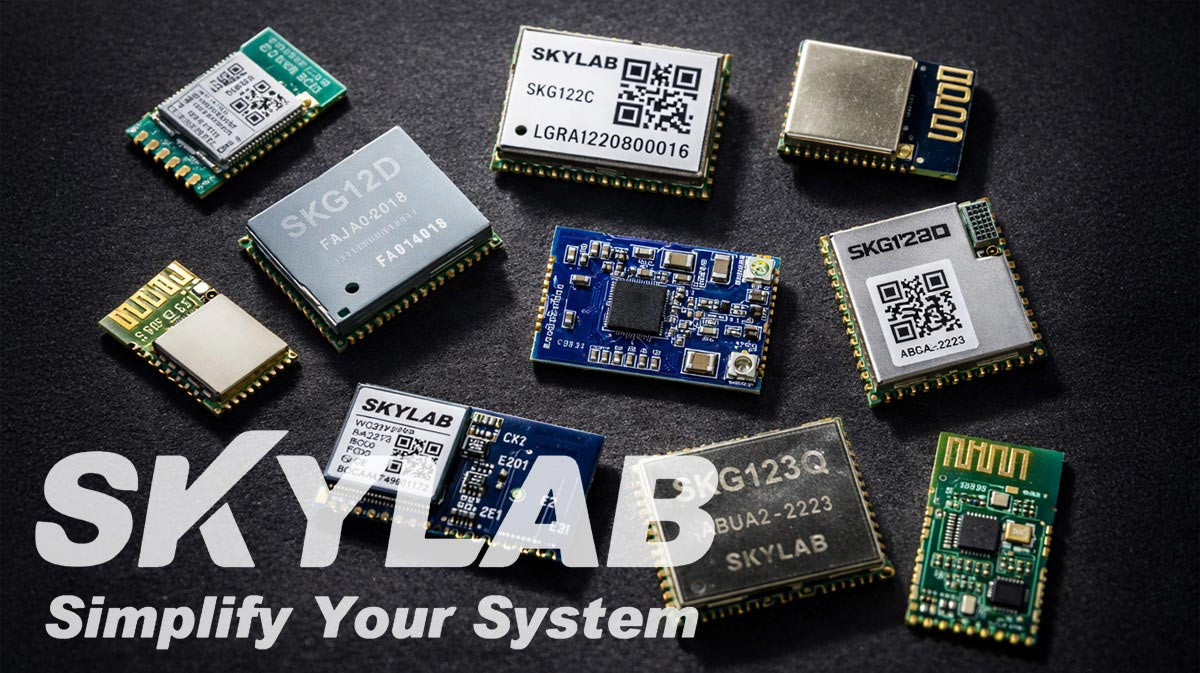
Skylab communication modules – connectivity you can rely on.
In an era of dynamic IoT technology development, wireless connectivity has become the foundation of modern systems – from logistics, through industry, to healthcare. Communication modules such as GPS, WiFi, Bluetooth play a key role in monitoring, tracking and process automation. Each of these technologies serves a different function: WiFi provides Internet access, Bluetooth enables short-range communication, and GPS delivers precise location information. It is precisely in this area that Skylab specializes, having delivered reliable wireless solutions to customers all over the world for years.
Skylab M&C Technology Co., Ltd. is a Chinese technology company headquartered in Shenzhen, specializing in the design and production of communication modules and localization solutions. It has been operating on the market since 2002 and offers a wide range of products, including WiFi, Bluetooth, GPS, UWB modules and beacons. Skylab offers both ready-made modules and integration-ready solutions, which makes it a partner for companies and system integrators from all over the world. The company invests in quality (including ISO-9001, IATF-16949 certifications), complies with international standards such as FCC, CE, IC, SRRC, and develops its own algorithms and technologies – especially in the field of indoor positioning. Skylab products are used in very diverse areas – from consumer devices, through IoT, secure monitoring systems, systems for smart industry, to specialist applications such as facility monitoring and rescue systems.
From a celestial laboratory straight to your PCB… Skylab products in the Micros offer.
For many years, Micros has acted as an intermediary between manufacturers from Asia and Polish customers, specializing in introducing high-quality electronic components originating mainly from China to the market. Thanks to experience in supplier selection, knowledge of local regulations and technical background, Micros effectively adapts foreign solutions to the needs of Polish customers. An example of such cooperation is the offer of wireless modules of the Skylab brand, which – thanks to distribution by Micros – have become more easily available to companies designing systems in the field of IoT, automation or consumer electronics. The Micros offer includes selected Skylab modules, among others from the field of WiFi and Bluetooth communication, as well as GPS/GNSS localization modules. Micros also offers technical and logistical support, facilitating the integration of Skylab products in various applications, from IoT systems to consumer and industrial electronics.
Overview of Skylab products from the Micros offer - Bluetooth Modules
The SKB360 module is a relatively simple but functional Bluetooth 4.0 Low Energy module, which is an interesting choice for IoT applications, peripherals and simple wireless devices. It is based on the Nordic nRF51822 chip with an ARM Cortex-M0 core, which provides reasonable computing capabilities for a simple BLE application. It is equipped with various interfaces (including GPIO, UART, SPI, I2C, ADC), which allow integration with sensors, displays, etc., without the need to purchase additional hardware. It is characterized by low power consumption and although it is not the latest generation, the module has sleep modes and in standby mode allows battery saving. It is a mature and proven solution, with a relatively low cost, good when something working is needed without great requirements.
The SKB369 module is another proposal from Skylab, being a development of the SKB360 – newer, more powerful and compliant with newer Bluetooth versions. SKB369 supports Bluetooth Low Energy 4.2 / 5.0, which allows higher throughput, more stable connections and greater range. It is based on the Nordic nRF52832 system, with an ARM Cortex-M4F core (with floating-point unit), which provides significantly greater computing power compared to the Cortex-M0 in SKB360. Thanks to Cortex-M4F, it is possible to perform signal calculations, filtering, encryption algorithms or compression without the need for an additional MCU. It is equipped with memory: up to 512 kB Flash and 64 kB RAM, which allows more complex BLE applications, e.g. handling several profiles simultaneously. It also has NFC support, which is convenient for pairing, e.g. in mobile applications, and multiprotocol support, meaning that operation is possible not only in BLE, but also in ANT or other protocols supported by nRF52xx systems. As in the SKB360 module, the transmit power is limited to max. +4 dBm, therefore for applications requiring greater range, more powerful modules should be considered.
The SKB378 module is a newer and more advanced Bluetooth 5.2 Low Energy module from the Skylab offer based on the Silicon Labs EFR32BG22 system with an ARM Cortex-M33 core. The M33 core with a new power architecture is optimized for operation in very low power consumption modes (e.g. beacons, trackers). The module supports the latest BLE features, including longer range (LE Coded), higher throughput (2 Mbps) and better transmission reliability. It also supports localization functions, i.e. BLE AoA/AoD (Angle of Arrival / Angle of Departure). This is a positioning and localization technique in Bluetooth Low Energy 5.1+ technology that allows determining the direction from which the radio signal arrives (AoA) or in which it is transmitted (AoD). This approach allows positioning accuracy on the order of tens of centimeters, significantly better than in the case of classic RSSI. SKB378 provides hardware support for cryptography and AES encryption. It is a solution that works well in modern IoT applications requiring both low power consumption and new Bluetooth 5.2 features.
The SKB381 module is a more powerful variant from the BLE family, based on the modern Silicon Labs EFR32BG21 system, offering very good receiver sensitivity and the ability to operate with higher transmit power than earlier models. It is a Bluetooth 5.0 Low Energy module supporting new BLE modes: long range (LE Coded) and fast transmission (2 Mbps). It is characterized by high transmit power up to +20 dBm, therefore it is a great choice when the device must operate over longer distances or in difficult radio conditions, e.g. in halls or warehouses. Very good receiver sensitivity at the level of -104.9 dBm improves connection reliability, especially with weak signal. The modern Cortex-M33 MCU provides not only higher performance, but also better hardware support for cryptography. This solution is often chosen when greater range and hardware security are important in the project. However, higher power consumption when operating at high transmit power may not be optimal for battery applications.
The SKB501 module is one of the newest Skylab modules with Bluetooth 5.0 support and multiprotocol operation (BLE + ANT). It is aimed at more demanding IoT applications, where not only BLE connectivity matters, but also compatibility with the ANT-based ecosystem, used mainly in the sports and fitness industry. It is based on the nRF52840 SoC with a powerful ARM Cortex-M4F core enabling fast real-time data processing. NFC support facilitates pairing and configuration. The transmit power is limited to +4 dBm, therefore the range is shorter than, for example, for SKB381. It is characterized by higher current consumption than SKB378, although it is still a module optimized for IoT. It can be said that SKB501 is a module for applications requiring versatility and interoperability, while SKB381 focuses on long range, and SKB378 on energy efficiency and new BLE 5.2 features (AoA/AoD).
Summary – what to choose?
If you need the cheapest, basic BLE and simple peripherals are sufficient → SKB360 (BLE 4.0)
For versatility with a good price/performance ratio (BLE 4.2/5.0, NFC optional) → SKB369 (BLE 4.2/5.0)
When you care about modern BLE 5.2 features and AOA (localization) as well as a more powerful MCU → SKB378 (BLE 5.2)
If you need high transmit power, better sensitivity, long range and hardware security → SKB381 (BLE 5.0)
For multiprotocol IoT solutions (BLE5 + ANT) and readiness for commercial applications → SKB501 (BLE 5.0)
|
Symbol |
Chip |
Bluetooth standard |
Antenna |
Transmit power |
Receiver sensitivity |
Supply voltage |
Dimensions |
Case |
|
nRF51822 |
BLE 4.0 |
PCB |
4dBm |
-93dBm |
1,8~3,6V |
17,4×13,7×1,9 mm |
SMT 25-pad |
|
|
nRF52832 |
BLE 4.2/5.0 |
PCB |
4dBm |
-96dBm |
1,7~3,6V |
17,4×13,7×1,9 mm |
SMT 25-pad |
|
|
EFR32BG22 |
BLE 5.2 |
PCB/zł. IPEX |
6dBm |
-106,7dBm |
1,71V~3,8V |
17,4×13,7×1,9mm |
SMT 25-pad |
|
|
EFR32BG21 |
BLE 5.0 |
PCB/zł. IPEX |
20dBm |
-104,9dBm |
1,71V~3,8V |
20×12×2,4mm |
SMT 23-pad |
|
|
nRF52840 |
BLE 5.0 |
PCB |
8dBm |
-96dBm |
1,7V~3,6V |
17,4×13,7×1,9mm |
SMT 26-pad |
Table 1. Skylab Bluetooth modules in the Micros offer
GNSS Modules
The GNSS SKG122C module is a compact solution based on a single L1 band, supporting all major GNSS systems (GPS, BDS, GLONASS, Galileo, QZSS), thus offering broad compatibility. The SKG122C module provides solid performance in a compact form factor and is ideal for applications in environments with a moderate level of interference and where basic GNSS navigation is sufficient. Its versatility and ease of integration make it a popular choice in various applications.
SKG12D uses the well-known and proven MediaTek MT3333 chip, which offers better performance and signal stability, which is important in applications requiring high precision. It is optimized for low power consumption. The time from receiver start to first position fix (TTFF) in open space is about 23 seconds (vs 28 seconds for SKG122C). This means that SKG12D finds its position faster after power-up, which is important, for example, for devices that are frequently switched on or reset. SKG12D operates at a supply voltage of up to 4.2 V maximum, while SKG122C – up to 3.6 V. The wider range may provide greater flexibility in power source selection and in situations where the voltage drops slightly.
Additional features improving operation include:
Always Locate™ – an intelligent power management mode. The module dynamically switches between normal mode and sleep mode depending on signal quality and application needs. As a result, power consumption is significantly reduced while maintaining continuous position tracking.
AIC (Active Interference Cancellation) – active multi-tone interference reduction. The module can actively detect and eliminate 12 different interference tones simultaneously, e.g. from LTE modems, WiFi or other RF sources. This function allows the module to operate stably in environments with strong RF interference, e.g. in cities, near GSM/LTE base stations or WiFi hotspots.
EPO™ (Extended Prediction Orbit) – satellite orbit prediction function. It allows fast startup even without access to the GNSS network by externally downloading satellite orbit data, e.g. from the Internet, and storing it in the module memory. Enables fast TTFF even in “cold start”.
EASY™ (Embedded Assist System) – a function supporting faster position fixing. The module can independently predict satellite positions based on data from the previous position fix without the need for continuous network connection. Therefore, it works without connecting to a server, it is enough that the module was recently active. This allows achieving a very fast “hot start” at about 1 second.
The module is also equipped with mechanisms for eliminating errors related to secondary wave interference (so-called multipath) caused by the fact that the GNSS signal reaches the receiver not only directly from the satellite, but also after reflection from various objects such as buildings, vehicles, walls, windows, trees, etc. The module analyzes the signal characteristics and detects that part of the signal is reflected rather than direct from the satellite and corrects position calculations, eliminating or minimizing the impact of reflected signals. As a result, we obtain a more accurate position in difficult environments, both outdoors and indoors or in partially covered spaces.
A limitation of the SKG12D module is the ability to use a maximum of two GNSS systems, i.e. GPS + 1 other system (e.g. GPS+BDS, GPS+GLONASS, GPS+Galileo).
SKG123Q is based on the modern Airoha AG3352 chipset and is designed to support the full set of GNSS systems (GPS, BDS, GLONASS, Galileo, QZSS) simultaneously. Thanks to this, it can in practice provide the best coverage and highest accuracy in difficult terrain conditions, e.g. in cities or mountains. It also has navigation-supporting functions such as:AIC – reduction of interference from other radio signals,
EPO™ / ELPO™ / EPOC™ – functions accelerating first fix acquisition using satellite orbital data,
LOCUS™ – position logging in internal memory allowing the module to operate as a simple route recorder without an additional MCU.
SKG12D is a better choice where stability, low power consumption and interference resistance matter, e.g. in mobile devices, long-life battery trackers, IoT. SKG123Q, on the other hand, will be a better choice where accuracy and reliability in difficult conditions are the priority, thanks to simultaneous support of multiple constellations, e.g. car navigation, drones, surveying systems.
|
Symbol |
Chip |
Supported systems |
Signal acquisition / tracking sensitivity |
TTFF (Time To First Fix, cold start) |
Supply voltage |
Dimensions |
Case |
|
b/d |
GPS, BDS3, GLONASS, Galileo, QZSS |
-148dBm/-162dbm |
28s |
3~3.6V |
16×12,2×2,4mm |
SMT 24-pad |
|
|
AG3352 |
GPS, BDS3, GLONASS, Galileo, QZSS |
-148dBm/-165dbm |
32s |
3~3.6V |
16×12,2×2,4mm |
SMT 24-pad |
|
|
MT3333 |
GPS + BDS3 / GLONASS / Galileo / QZSS |
-148dBm/-165dbm |
23s |
3~4.2V |
16×12,2×2,4mm |
SMT 24-pad |
Tabela 2. Moduły GNSS firmy Skylab w ofercie Micros
WiFi Modules
WiFi module WG209 is a compact USB device based on the MT7601 chipset, supporting 802.11 b/g/n standards in the 2.4 GHz band. WG209 is an ideal solution for devices that require basic WiFi connectivity in the 2.4 GHz band. Its small dimensions and low power consumption make it suitable for integration in various applications such as set-top boxes, IP cameras, printers, IoT devices, home gateways.
WG217 is a WiFi module based on the Realtek RTL8811 chipset, supporting 802.11 a/b/g/n/ac standards in the 2.4 GHz and 5 GHz bands. It offers higher data transmission speed (up to 433 Mbps) thanks to support for the 802.11ac standard, making it suitable for applications requiring higher bandwidth, such as IP cameras or Internet television.
WG233 is a WiFi module based on the Realtek RTL8812 chipset, supporting 802.11 a/b/g/n/ac standards in the 2.4 GHz and 5 GHz bands. Thanks to two streams (2T2R) and 5 GHz band support, it provides the highest transmission speed (up to 867 Mbps), making it suitable for the most demanding applications such as advanced monitoring systems or IoT devices.
|
Symbol |
Chip |
WiFi standard |
Supply voltage |
Transmission speed |
Dimensions |
Case |
|
MT7601 |
802.11 b/g/n |
3.6÷7V |
150 Mbps |
30×15×2,4mm |
SMT8 |
|
|
RTL8811 |
802.11 a/b/g/n/ac |
3.6÷7V |
433 Mbps |
36×15×3,2mm |
SMT8 |
|
|
RTL8812 |
802.11 a/b/g/n/ac 2T2R |
3÷3.6V |
867 Mbps |
29×17×2,8mm |
SMT12 |
Table 3. Skylab USB WiFi modules in the Micros offer
Summary
Wireless communication today is not a luxury but a necessity both in smart cities and in warehouses, hospitals or production lines. Thanks to modern IoT modules, precise object localization, remote data management and automation on an unprecedented scale are possible. Skylab is one of the significant manufacturers of these solutions, combining reliability, innovation and global reach. Thanks to cooperation with Micros, innovative Skylab technologies – from high-accuracy GNSS modules, through energy-efficient Bluetooth modules, to efficient Wi-Fi systems – are easily available on the local market, with quality guarantee and technical support.